
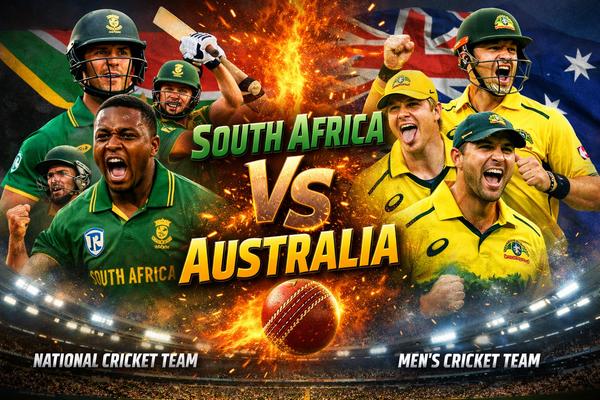
South Africa National Cricket Team vs Australian Men’s Cricket Team Timeline
Some rivalries shout for attention. Others quietly build tension and then explode when the stakes rise. The South Africa vs Australia cricket rivalry sits firmly in the second category. It does not always dominate headlines, but when these two teams collide, things rarely stay calm.
You get aggressive fast bowling, elite fielding, sledging that sometimes crosses the line, and matches that swing wildly. You also get unforgettable performances that stick in your mind for years. So let’s walk through the full South Africa National Cricket Team vs Australian Men’s Cricket Team timeline, with accurate stats and a deeper look at those iconic knocks that shaped this rivalry.
Early Years: Australia Sets the Benchmark
First Test Encounters (1902–1930s)
South Africa and Australia first met in Test cricket in 1902. Australia entered as the stronger side with more experience and a well-established cricket system.
Australia dominated early series with consistent batting and disciplined bowling. South Africa showed flashes of brilliance but lacked the depth needed to compete over long series.
Bradman Era Impact
When Sir Don Bradman entered the scene, things tilted even further. Australia’s batting strength became overwhelming.
South Africa struggled to contain Australia’s run-scoring machine. Still, they developed a reputation for producing gritty players who refused to back down.
Apartheid Era: A Forced Pause
Isolation from International Cricket
South Africa’s apartheid policies led to their exclusion from international cricket in 1970. That decision paused all official matches with Australia for over two decades.
Australia continued evolving during this period. South Africa missed valuable years of competition and development.
What Did Cricket Miss?
Imagine peak Australian sides facing South African talents during those years. The rivalry could have matured much earlier.
Instead, it paused and waited. When South Africa returned, they brought intensity that made up for lost time.
1990s: Rivalry Reignites with Immediate Heat
South Africa’s Return (1991 Onwards)
South Africa re-entered international cricket in 1991, and they wasted no time. They immediately faced strong teams, including Australia.
The contests felt intense from the beginning. Both teams played aggressive cricket, and neither side liked giving an inch.
1999 World Cup Semi-Final: Cricket’s Most Painful Tie
This match still hurts if you support South Africa. It still fascinates if you love drama.
- South Africa needed 1 run from 4 balls with 1 wicket left
- Lance Klusener hit consecutive boundaries and almost sealed the win
- A miscommunication with Allan Donald caused a run-out
- The match ended in a tie (213–213)
- Australia advanced to the final
This moment defined South Africa’s reputation for heartbreak and Australia’s knack for surviving pressure.
Early 2000s: Rivalry Turns Personal
Australia’s Dominance Meets South African Resistance
Australia dominated world cricket during the early 2000s. Players like Ricky Ponting, Glenn McGrath, and Shane Warne led a ruthless team.
South Africa responded with Jacques Kallis, Shaun Pollock, and Graeme Smith. They pushed Australia harder than most teams.
Physical and Mental Battles
Matches often turned into psychological warfare. Players exchanged words constantly. Fast bowlers targeted batsmen aggressively.
You could feel tension even through the TV screen. These games stopped being just cricket matches and started feeling like contests of pride.
2006: The Match That Changed ODI Cricket Forever
Australia’s 434/4 – A Record Total
In Johannesburg, Australia smashed 434/4, the highest ODI total at the time. Ricky Ponting led with a brutal 164 off 105 balls.
Most teams would have accepted defeat right there. South Africa chose chaos instead.
South Africa’s 438/9 – The Impossible Chase
South Africa chased down 438 in the same match. That still sounds ridiculous.
Herschelle Gibbs delivered one of the greatest ODI innings ever. He scored 175 off 111 balls, hitting 21 fours and 7 sixes.
Mark Boucher finished the game with a boundary in the final over. The crowd erupted, and cricket changed forever.
Why This Knock Still Matters
Gibbs did not just score runs. He rewrote what teams believed possible in ODI cricket.
He attacked relentlessly, ignored scoreboard pressure, and turned an impossible chase into reality. That innings still ranks among the best in ODI history.
Late 2000s to Early 2010s: South Africa Peaks
South Africa Becomes World No. 1 in Tests
South Africa reached the No. 1 ICC Test ranking in 2012. They defeated Australia in key away series, including a famous win in Perth.
Hashim Amla, AB de Villiers, and Dale Steyn drove this success. They combined technical brilliance with aggressive intent.
AB de Villiers vs Australia
AB de Villiers produced several unforgettable innings against Australia. One standout came in 2012 at Perth, where he scored 169 runs under pressure.
He played with control and aggression, countering a strong Australian bowling attack in difficult conditions. That innings helped South Africa secure a crucial series result.
2014–2016: Australia Fights Back
Mitchell Johnson’s Aggression
Australia regained dominance with players like Mitchell Johnson. His pace and hostility troubled South African batsmen.
Series during this period featured intense fast bowling battles. Matches often swung based on short bursts of brilliance.
Steve Smith’s Rise
Steve Smith emerged as Australia’s batting backbone. He consistently scored against South Africa in tough conditions.
His unconventional technique frustrated bowlers and delivered results repeatedly.
2018: Sandpaper Scandal Shakes Cricket
What Happened in Cape Town?
During a Test match in Cape Town, Australia attempted ball tampering.
- Cameron Bancroft used sandpaper on the ball
- Television cameras caught the act
- Steve Smith and David Warner admitted involvement
The fallout hit hard. Cricket Australia banned key players, and the team’s reputation suffered globally.
Impact on the Rivalry
The incident added controversy to an already intense rivalry. South Africa maintained composure, while Australia faced heavy criticism.
This moment shifted public perception and created a new chapter filled with tension and scrutiny.
Modern Era: Competitive Across All Formats
T20 Cricket Adds Chaos
T20 matches between these teams deliver fast-paced entertainment. Big hitters, clever bowlers, and unpredictable outcomes dominate.
Players like Quinton de Kock and Glenn Maxwell bring explosive energy to these contests.
ODI and Test Balance
Both teams continue competing closely in ODIs and Tests. Australia often edges major tournaments, while South Africa remains dangerous in bilateral series.
Matches rarely feel one-sided. That keeps fans invested.
Head-to-Head Statistics (Accurate Overview)
Here is a consolidated statistical snapshot across formats (updated to recent records):
| Format | Matches | Australia Wins | South Africa Wins | Draw/Tie/NR |
|---|---|---|---|---|
| Tests | 101 | 54 | 26 | 21 Draws |
| ODIs | 110 | 51 | 55 | 4 NR/Ties |
| T20Is | 25 | 14 | 11 | 0 |
These numbers show how competitive the rivalry has become, especially in ODIs.
Memorable Knocks That Defined the Rivalry
Here is where things get really interesting. Let’s go deeper into some iconic innings that shaped this rivalry.
Herschelle Gibbs – 175 vs Australia (2006)
This innings stands as one of the greatest ODI knocks ever.
- Gibbs attacked from ball one
- He targeted bowlers like Brett Lee without hesitation
- He maintained a strike rate above 150
- He handled scoreboard pressure brilliantly
He turned a 434 chase into a realistic target. Without this innings, that match would never have become historic.
Ricky Ponting – 164 vs South Africa (2006)
Ponting’s innings often gets overshadowed, which feels unfair.
- He dominated the middle overs
- He accelerated perfectly toward the end
- He led from the front as captain
His knock set up Australia’s massive total. Without it, the match would not have reached legendary status.
AB de Villiers – 162* vs Australia (2016, ODI)
AB delivered a masterclass in controlled aggression.
- He switched gears effortlessly
- He targeted weak bowling phases
- He finished unbeaten, ensuring maximum impact
He made chasing or setting targets look easy, even against strong attacks.
Faf du Plessis – 110 vs Australia (2018 Test, Adelaide)
Faf played one of the grittiest innings in modern Test cricket.
- He absorbed pressure for long periods
- He built partnerships under difficult conditions
- He led by example as captain
This innings highlighted South Africa’s resilience in tough conditions.
Steve Smith – 141 vs South Africa (2014 Test, Centurion)
Smith showed why he dominates Test cricket.
- He adapted quickly to South African conditions
- He handled pace and bounce effectively
- He built his innings patiently
His knock anchored Australia’s innings and demonstrated his consistency.
Memorable Performances Summary Table
| Player | Format | Score | Venue | Impact |
|---|---|---|---|---|
| Herschelle Gibbs | ODI | 175 | Johannesburg | Historic chase |
| Ricky Ponting | ODI | 164 | Johannesburg | Set 434 total |
| AB de Villiers | ODI | 162* | Johannesburg | Dominant finish |
| Faf du Plessis | Test | 110 | Adelaide | Match-saving innings |
| Steve Smith | Test | 141 | Centurion | Anchored innings |
These innings did not just win matches. They shaped how fans remember this rivalry.
Playing Styles: Why Matches Feel So Intense
Australia’s Style
Australia plays aggressive, result-oriented cricket. They push opponents mentally and physically.
They thrive under pressure and rarely hesitate to dominate situations.
South Africa’s Style
South Africa relies on balance and discipline. They produce world-class fast bowlers and dependable batsmen.
They focus on resilience and adaptability.
The Collision Effect
When these styles clash, matches feel explosive. One team attacks relentlessly, while the other absorbs pressure and counters smartly.
That contrast creates drama every time.
Why Fans Love This Rivalry
You do not need constant hype to enjoy this rivalry. The cricket speaks for itself.
- Close contests
- High-quality performances
- Emotional moments
Fans know they will get value whenever these teams meet.
Conclusion: A Rivalry Built on Drama and Excellence
The South Africa National Cricket Team vs Australian Men’s Cricket Team timeline tells a story of evolution, intensity, and unforgettable moments.
Australia leads historically, especially in Tests, but South Africa consistently challenges them across formats. The rivalry thrives because both teams refuse to back down.
And honestly, that is what makes it special. No easy wins, no predictable outcomes, just pure cricketing drama.
If you ever doubt how good cricket can get, just revisit that 2006 game or the 1999 semi-final. Those matches remind you why this rivalry still matters.